
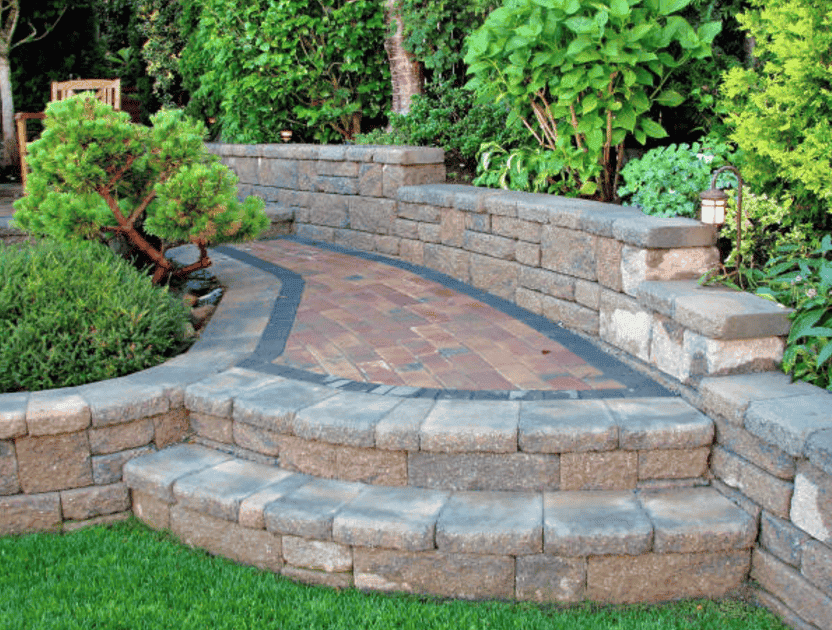
If you’re planning on adding a retaining wall to your yard, you’re probably considering cost as one of the most important factors. But the true focus should be on a part of the job that you can’t even see once it’s finished: the retaining wall’s drainage.
The system used to prevent water buildup and pressure behind your retaining wall is what determines if a wall will last 30 years or fail after two.
Water is the true enemy of all retaining walls, and with the steep hills throughout Pittsburgh, you’ll need to understand the importance of drainage before your retaining wall is installed.
Water Is the #1 Enemy of Retaining Walls in Pittsburgh’s Hilly Terrain
Water can cause your retaining wall to crack, lean, bulge, and tip. Why? Water follows gravity and slopes, and with the hills around Pittsburgh, it’s constantly moving downhill toward something. Because retaining walls are built to stabilize hills, that water will be heading straight toward the wall. The problem is, the water then collects in the soil behind the retaining wall, making the soil heavy and pushing it outward into the wall with a force known as hydrostatic pressure.
Because the water has nowhere else to go, the pressure keeps pushing, causing costly damage to your wall.
In Pittsburgh, the slopes are not the only threat, because the area is also prone to “freeze-thaw” winters. Snow melts into water during the day and works its way into cracks and spaces in the ground, then refreezes into ice at night. That ice expands and can make any existing cracks in your wall bigger. So, the true test of a good retaining wall is how well it moves water to keep these problems from happening.
What Good Drainage Actually Is
To keep water from building pressure against your wall, you need a proper drainage system in place. Such systems sit buried beneath the finished block face of the wall, doing the behind-the-scenes work that keeps it looking sharp and staying strong for years to come. Your retaining wall drainage system should include:
12+ inches of clean, angular drainage stone – The clean stone, featuring no dust or sand, lets water move freely
4-inch (or larger) perforated pipe at the base of the stone – The perforated pipe collects and carries water away from the wall, relieving the pressurer
Filter fabric – This keeps soil from clogging the stone over time
Grading at the surface – Grading gives water a direction to travel, so it flows away from the wall and not toward it
Base course buried below grade and set on compacted stone – A properly set base course keeps the wall from sinking or shifting under pressure
A retaining wall’s drainage is not just one pipe – it’s a system of parts working together to keep water pressure off the wall. As the wall gets taller, the drainage zone gets deeper, which is why these projects can turn into large-scale excavations. It’s a necessary part of the build, and it’s what keeps your wall functioning for the long run. Collecting the water is only half the battle, though. It needs an exit point.
What Daylighting Means and Why Drainage Pipes Need an Exit Point
Because all of the pipes behind your wall are buried, they need an exit. Without one, the pipes simply fill up and do nothing to move water away from the wall.
This is where daylighting comes in. Daylighting just means giving the buried pipe a surface exit for the water to come out of. When that buried perforated pipe is routed to a lower point in your yard, it works as a daylight French drain system, carrying collected water safely away from the wall.
The three main exit options are a lower spot in your yard along a planned path, a connection into a storm drain, or the face of the wall itself using small, intentional drains, called slit drains.
Whichever option you choose, your retaining wall drainage system must have a daylight point. Without one, the water builds up and creates pressure as if the system weren’t even there.
Slit Drains in the Wall Face
As noted above, one of the daylighting options involves using a series of slit drains, which are small drains set into the wall face. They connect to the perforated pipe in the back and bring water to the front, facilitating flow control. Unlike crude weep holes, slit drains are discreet and blend into the wall face, giving you a clean-looking, effective drainage solution.
What Happens When Drainage Is Done Incorrectly: Real Examples from Our Experience
Drainage isn’t always set up correctly, and the fallout can show up years later. We’ve corrected plenty of these problems, and the repairs aren’t cheap. Here’s a quick list of the shortcuts we’ve seen and the damage they caused, so you know what to look out for:
A retaining wall is an investment, and one you want to last. The cheapest quote can look appealing up front, but the cost of repairing a wall built on poor drainage will hurt you far more in the long run.
Signs of Failing Drainage in Your Existing Retaining Wall
If you already have a retaining wall, there are a few signs you can watch for after heavy rain to tell whether your drainage is working. Catching failing drainage in retaining wall systems early can save you from a much larger repair bill down the road.
Important
These signs are meant as a guide, not an evaluation of your specific wall. If you suspect a problem, get in touch with a professional.
Signs that your wall may not be draining properly include:
- Standing water or saturated soil at the base of the wall
- Persistent damp patches on the wall face
- Leaning or bulging of the wall
- Soil or mulch washing out from behind the top
- No water at the daylight exit after a storm
NDS Drainage Certification
When you’re choosing a team to install your retaining wall, you will want to find out if they hold an NDS Drainage Certification. NDS is a leading residential drainage and water-management brand, and an NDS Certified Drainage Contractor is someone who has been trained and tested specifically on moving water, runoff, and drainage design. Earning the credential takes time, knowledge, and commitment, which makes it a useful signal when you’re looking for a contractor you can trust.
Stockman Lawnscape is focused on getting the job done right the first time. That’s why our crews hold the NDS Drainage Certification, along with certification from the Concrete Masonry & Hardscapes Association (CMHA) for segmental retaining walls (SRW) and other installation credentials.
As a family-owned business based in Pittsburgh, we bring local knowledge of the hills and climate that we’ve built over more than 30 years in the field. Our training in proper drainage techniques means we’ll build your retaining wall to last through every slope and freeze-thaw winter it faces. If you’d like a free quote, contact us and see how we can help transform your outdoor space.
Recent Comments