
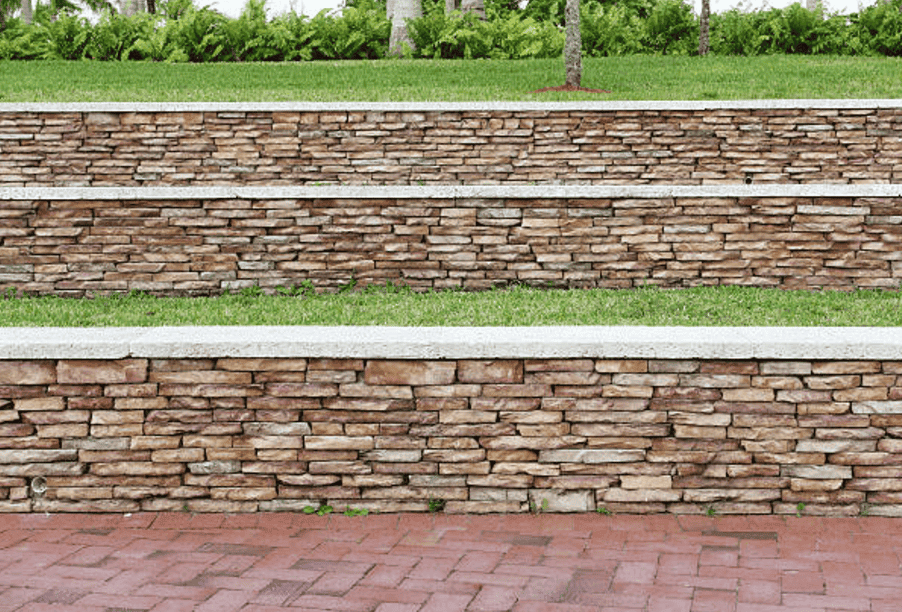
Around Pittsburgh, retaining walls are part of the landscape since many hills practically require them. You will find one holding back a slope on almost every other property. That also means a lot of walls are quietly working overtime against gravity, groundwater, and freeze-thaw cycles.
A retaining wall rarely gives out all at once. It shows signs of trouble first and catching these issues early is the difference between a one-day fix and a full wall rebuild. So, what are the signs of a failing retaining wall? Below, we outline seven retaining wall warning signs, what tends to cause them, and how to handle the retaining wall problems homeowners shouldn’t ignore.
1. The Wall Is Leaning or Tilting Forward
This is the clearest sign of trouble. A healthy wall stands vertical. When it starts to tip or push outward at the top, pressure has built up behind it, and the structure is starting to lose the fight against gravity. Leaning walls do not correct themselves. Once a wall begins to push forward, it tends to keep moving until something is done about it, and eventually it can fail outright.
2. Bulging or Bowing in the Face
Look down the length of the wall. A straight wall should read as a clean line. If one section bulges or bellies outward while the rest holds its line, the soil and water behind that spot are overpowering the block. Bowing is movement in progress, and it usually points to a drainage or backfill problem rather than a surface issue.
3. Cracking
Cracks running through blocks or along seams signal that the wall is under stress it was not built to carry. Hairline cracks can be cosmetic, but stair-step cracking, widening gaps, or cracks paired with any leaning deserve a closer look. In our climate, water gets into a crack, freezes, expands, and makes the crack worse with every cold snap.
4. A Wavy or Sinking Top Course
Look across the top of the wall – if the line dips, rolls, or waves instead of running level, the base underneath has shifted. This almost always traces back to how the wall was initially built. When the base was not excavated deep enough and compacted correctly, gravity does its work over the seasons and the wall settles unevenly.
5. Separating or Gapping Blocks
Gaps opening between blocks, or between whole sections of the wall, mean the structure is pulling apart. You may notice daylight where blocks used to sit tight, or sections that no longer line up the way they did when the wall was new. Separation is a sign the wall is moving, and movement is what comes before failure.
6. Water Seeping, Pooling, or Draining Oddly
Water is the enemy of any retaining wall, so if there is any water present, pay attention to what it’s doing. A properly built wall handles water quietly through the gravel and drainage behind it, so you should not see much at all. When you see water streaming out of a wall drain, pooling at the base, or staining the face, or a drain that looks clogged, you should start investigating. It usually means water is collecting behind the wall instead of being carried away, and that pressure is what pushes walls over.
Water is the enemy to everything on the hardscaping side – standing water, sitting water, drainage coming down a hill. The drainage has to be done properly, and you have to know your terrain.
— Nathan Stockman
President, Stockman Lawnscape
7. Soil Erosion or Washout Behind the Wall
If the ground behind or above the wall is washing out, sinking, or forming voids, the wall is no longer holding the slope the way it should. Erosion behind the wall and movement in the wall feed each other, so erosion control measures are often needed alongside any wall repair.
Why Retaining Walls Fail in Pittsburgh
Most retaining wall failure comes down to a few causes, and almost all of them start out of sight, behind the block.
Poor Drainage
Standing water and runoff coming down a hill has to go somewhere. When water collects behind a wall, it adds enormous pressure. Any wall built without proper drainage behind it is fighting a battle it will eventually lose.
An Improper Base
A retaining wall is only as good as what sits beneath it. The base must be excavated below grade, with block buried underground and the gravel compacted correctly. When that compaction is skipped or rushed, the wall settles and you get the wavy, uneven line described above.
Missing or Undersized Geogrid
For taller walls, geogrid is the fabric that locks back into the hillside between courses of block and ties the structure into the slope. Any wall over four feet should be engineered and built with geogrid set back at the correct distance.
When a builder skimps on the gravel and geogrid and packs dirt straight against the block instead, the wall has nothing anchoring it, and it starts to push forward. If you are planning a new wall, it’s worth understanding what goes into building a retaining wall the right way before work begins.
A lot of times when walls push over and start to fall forward, it’s because the area behind them was not excavated properly. Some companies skimp on the gravel back there and dirt gets packed right against the wall, so over time the wall just starts to push over and eventually fails.
— Nathan Stockman
President, Stockman Lawnscape
A good share of the retaining wall repair calls we get are walls built by someone that failed for exactly the reasons we’ve listed.
How NDS Certification Protects Your Wal
Because water sits at the root of most wall failure, managing it well is what gives a wall its 25 to 30 years of life, instead of falling after a few years. Stockman Lawnscape holds the Professional Drainage Contractor Certification through NDS, a leading drainage-systems manufacturer, and the certification carries continuing-education credits from the National Association of Landscape Professionals.
The training behind that certification is exactly what a long-lasting wall needs. It covers how to read a property’s rainfall, runoff, soil, and slope; how to diagnose the drainage problems that cause most wall failures; and how to design systems for capturing, filtering, and carrying water away. In practical terms, it means our team plans for where water goes before a single block is set, rather than reacting after a wall has already started to move.
A properly placed French drain often relieves the groundwater pressure that pushes walls over, and the same read on grading and runoff protects patios and the rest of your property from the same forces.
Repair or Replace: How to Tell the Difference
Not every troubled wall needs to come down. The right call depends on what is actually failing.
A wall is often repairable when the problem is at the surface, and the foundation underneath is still sound. A wall that has shifted or settled but sits on a solid base can frequently be restacked, sometimes reusing the existing block, which keeps the cost down. These are the quicker fixes, often handled in a day.
A wall usually needs to be replaced when the failure is structural. If the base was built incorrectly, the drainage wasn’t installed, or the geogrid was left out, restacking the same block on the same flawed foundation only buys you time before the wall fails again. Walls that have leaned hard or pushed over are typically rebuilt with new material, so the new wall is engineered correctly from the ground up.
When Replacing Costs Less Than Repairing Again
It can feel cheaper to patch a wall and move on. But when the cause of failure is in the base, the drainage, or the missing geogrid, a repair that only addresses the surface leaves the real problem in place. The wall moves again, you pay for another repair, and the cycle repeats.
At some point, paying once for a wall built correctly costs less than paying again and again to prop up one that was not. A simple way to decide is to ask what is failing. If it’s the foundation, replacement is usually the more economical choice over time.
What to Do If You Notice a Problem
A failing wall is not an emergency you have to solve overnight, but a few steps will protect your property and your budget in the meantime:
- Watch it closely – Note whether the lean, crack, or bulge grows over a few weeks. Take a few photos from the same spot over time to make any movement easy to see.
- Move water away from it – Clear any clogged wall drains and redirect downspouts or runoff that feed water toward the wall. Less water buys you more time before the wall collapses.
- Protect the location – Keep people and vehicles clear of a wall that is leaning badly, especially above a patio, driveway, or play area.
- Check your insurance – Some wall damage may be covered depending on the cause, so it’s worth getting a documented quote before deciding how to proceed.
- Have the wall assessed – A professional can tell you whether you’re looking at a restack or a rebuild before the problem grows.
A failing retaining wall only gets more expensive the longer it waits. If you’ve noticed any of these warning signs, the team at Stockman Lawnscape can take a look and walk you through your retaining wall repair and installation options here in the Pittsburgh area.
Recent Comments