💡 Key Takeaways
- Material selection dictates lifespan and total cost – Though pressure-treated timber can provide the lowest upfront cost for customers ($10 to $25/square foot), the material’s 7- to 15-year lifespan and potential for rot make concrete blocks ($15 to $35/square foot, 50+ year lifespan) and natural stone ($25 to $50/sq ft, 50- to 100-year lifespan) the better choices for long-term application.
- Water management and base preparation prevent wall failure – Hydrostatic pressure from saturated soil can double the lateral force against a wall. To combat this, a professional 12-inch angular aggregate drainage column and perforated SDR-35 PVC pipe will often be installed to prevent bowing, leaning, and collapse.
- Height and soil triggers mandate engineering and permits – In most jurisdictions, retaining walls that exceed four feet in height or support sloped surcharges necessitate local building permits, geogrid soil reinforcement, and stamped engineering drawings.
Why Retaining Wall Material Choice Matters
Retaining walls can be beautiful, aesthetic additions to properties, but they also serve key practical functions by securing sloped areas and preventing active soil erosion.
Retaining walls hold back immense earth loads – made even greater by hydrostatic pressure doubling the lateral force compared to dry soil alone.
As homeowners make their selection between segmented concrete blocks, natural stone, poured concrete, and pressure-treated timber, they need key details on installation cost, total service lifespan, freeze-thaw resistance, lateral load capacity, and ongoing maintenance needs. Our guide covers it all.
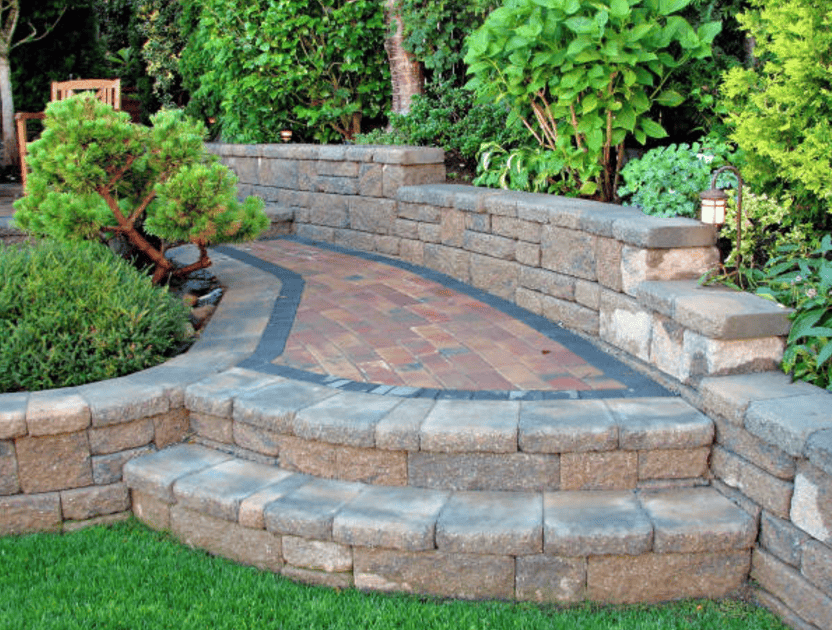
Block/Segmental Concrete Retaining Wall Facts
- These concrete block systems work by way of interlocking via mechanical lips, pins, or textured friction with built-in setback angles (typically 6° to 12°)
- They often sit on a compacted, crushed-stone base pad that’s half a foot to a foot deep, instead of poured concrete footing
- The systems are extremely durable, boasting a 20- to 50-year lifespan or more
⚠️ Height limit: Unreinforced gravity block walls have a limit of 3 to 4 feet for their exposed height. Beyond that height, or if the wall has been designed to support a slope/surcharge, they must have horizontal geogrid reinforcement layers to help anchor them into the soil mass.
Natural Stone Retaining Wall Facts
- These walls, made of natural stone or boulder terracing, offer a 50- to 100-plus-year functional lifespan that stands up to harsh freeze-thaw cycles found in regions like western Pennsylvania
- They often have a larger upfront cost, but their longevity makes them worthwhile additions to a home, and they can enhance property value
- Their material construction supports nearly any height or thickness requirement, but installation does need to be carried out by trained professionals
Poured Concrete Retaining Wall Facts
- These high-strength walls are ideal for significant structural loads, yards with steep grades, and tight site boundaries, and provide a 50- to 100-year lifespan
- They offer the highest compressive strength available along with the smallest footprint for retaining wall height
- They are constructed as solid gravity structures or engineered cantilever walls with an inverted T- or L-shaped reinforced footing that uses buried soil to prevent tipping
- Expansion joints, precise rebar placement, and poured footings are required below the local frost line to prevent cracking during freeze-thaw cycles
Timber Retaining Wall Facts
- These walls feature the lowest upfront cost when it comes to materials, and can be installed quickly with the aid of circular saws and rebar spikes
- The tradeoff to the cost benefit, however, is that these walls have the shortest lifespan of any retaining wall – 7–15 years – and can fall victim to accelerated rot, termite and carpenter ant infestations, and hardware corrosion
- Freeze-thaw and wet-dry cycles can also be a danger for these retaining walls, as water can get trapped against the wood and leach out the essential chemical preservatives
How to Choose the Right Material for Your Property and Budget
To decide on the best retaining wall material and approach for your project, you will want to coordinate with your landscaping/hardscaping team and review the following information:
Let Stockman Lawnscape Design a Beautiful Retaining Wall for Your Yard
The Stockman team has 25+ years of hardscaping experience, helping Pittsburgh-area homeowners improve their yard’s functionality, safety, aesthetic beauty, and curb appeal through expertly crafted retaining walls.
We can review retaining wall options with you, examining factors like cost, longevity, performance, and more to land on the best option for your project. Reach out to us today to get started!
Recent Comments